Transaction reporting technology
Simplify your MiFIR transaction reporting
eflow's technology centralises and automates all MiFIR transaction reporting requirements, including robust error handling and submission processes.
Simplify your MiFIR transaction reporting
eflow's technology centralises and automates all MiFIR transaction reporting requirements, including robust error handling and submission processes.
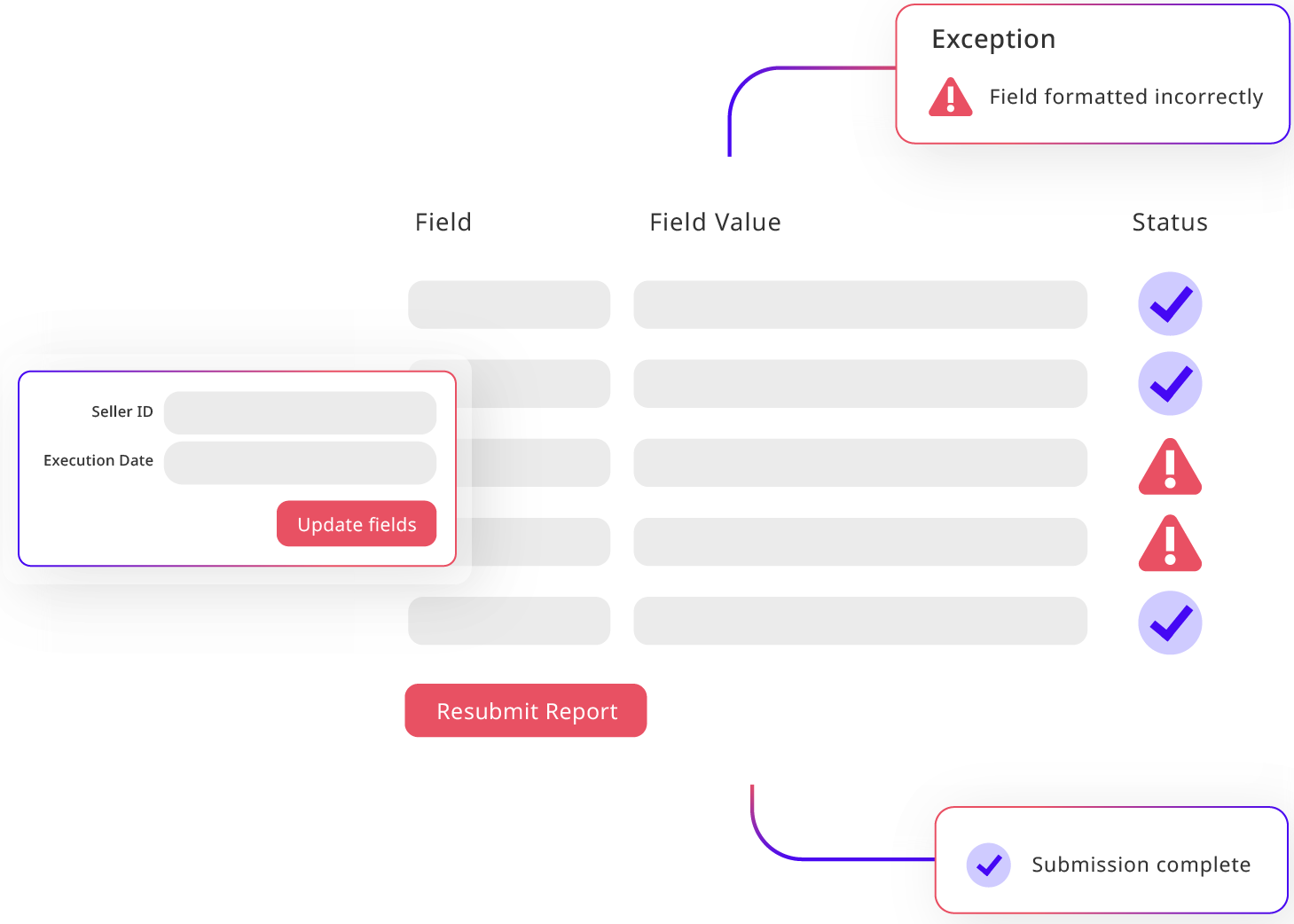







Transaction reporting is the obligation for investment firms to send their regulator full details of each reportable trade by the end of the next working day. Under MiFIR, reports go through an Approved Reporting Mechanism (ARM). eflow's transcation reporting software automates this process, checking every field before submission so errors are caught before the regulator sees them.
Using a robust combination of data enrichment, validation and report automation, eflow's technology includes three-way data reconciliation, error handling, automatic submissions, and field-by-field editing as standard. This means it quickly identifies discrepancies, including unreported transactions or reportable transactions, facilitates their immediate resolution, and streamlines the correction process by enabling firms to directly amend and reconcile trades.
Streamline your MiFIR reporting processes through seamless workflow automation and data submission to an approved reporting mechanism (ARM).
Automated data reconciliation, error handling and report submissions save time, effort and resources across your team.
Processing thousands of data points accurately is tough; let eflow’s technology do the heavy lifting for you.
No missteps or incorrect report submissions – just fully compliant reporting for complete peace of mind.
Say goodbye to manual data processes, wasted resources, and analyst fatigue; fully automated transaction reporting is here.
Enjoy the peace of mind that comes with direct access to eflow's team of onboarding specialists, customer success managers and technical experts.
Book an interactive demo to see how we can help you to manage your regulatory challenges in a more robust, streamlined and efficient way.

Switching transaction reporting systems is often one of compliance’s most resource-intensive projects, with data analysis, configuration, testing and sign-off competing with day-to-day duties. Many firms 'make do' with their existing technology, deterred by hefty implementation fees and past onboarding experiences marked by limited support, unclear ownership and outsourced service. eflow removes this barrier, combining technology, automation and expertise to deliver value fast.

Strengthen your transaction reporting through a centralised digital system that provides ‘one source of the truth’.
Three-way data reconciliation, error handling, automatic submissions and field-by-field editing all included as standard.
Back-test your trade data and generate highly detailed reports to satisfy the most granular of requests from regulators.
Automate your transaction reporting to drive efficiency, reduce operational backlogs and free up resources.
Seamless migration from your existing system to ensure zero periods of ‘regulatory downtime’.
Enjoy the peace of mind that comes with direct access to eflow's team of onboarding specialists, customer success managers and technical experts.
The eflow transaction reporting system will automatically upload your trade data, enrich it through the eflow Market Data Store (MDS), and then cross reference these records against the FIRDs register to perform a three-way reconciliation to ensure its accuracy. It will then generate reports directly from your validated data and submit these automatically to the relevant regulatory authority.
Once the reports have been submitted, you can review feedback in the platform before ingesting the regulator’s response files. These can then be used to make field-by-field edits for resubmission. This end-to-end process is fully automated by the system’s built-in workflows which strengthen the accuracy of the data being captured, while also providing a complete digital audit trail of every action taken across the platform. This not only reduces the risk of reporting errors but simplifies the reporting of vital management information and drives operational efficiency.


MiFIR transaction reporting requires investment firms to report details of reportable transactions in financial instruments to their national competent authority, such as the FCA, BaFin and AMF in Europe by the end of the following working day (T+1). Reports contain up to 65 fields covering the instrument, price, quantity, buyer, seller and decision-maker, and are usually submitted through an approved reporting mechanism (ARM).
eflow Transaction Reporting centralises and automates MiFIR reporting. It uploads trade data, enriches it through the eflow Market Data Store, cross-references records against FIRDS, runs a three-way reconciliation, then generates and submits reports automatically. Regulator feedback is ingested so errors can be corrected field by field and resubmitted.
Investment firms authorised under MiFID II or the UK equivalent must report the execution of trades in reportable financial instruments, operators of trading venues (such as exchanges, MTFs, and OTFs), UK/EEA branches of third-country investment firms, and credit institutions carrying out investment services. eflow Transaction Reporting is built specifically for these MiFIR obligations.
Three-way reconciliation compares a firm's internal trade records, the reports it submitted, and the data held by the regulator or ARM, to find missing, extra or inaccurate reports. eflow runs this automatically in real time, identifying unreported or over-reported transactions so firms can amend and resubmit quickly. The FCA and other regulators expect firms to reconcile reports regularly.
eflow automatically cross-references every record against the FIRDS register (the Financial Instruments Reference Data System) to confirm whether an instrument is reportable. Trade data is also validated and enriched against multiple industry sources through the eflow Market Data Store, reducing the risk of missing or incorrect reports.
Yes. eflow generates reports from validated data and submits them automatically through approved reporting mechanisms (ARMs). It is digitally connected to a range of global ARMs and NCAs.
eflow ingests regulator and ARM response files directly into the platform, so compliance teams can review rejections and errors in one place. Records can be corrected with field-by-field edits and resubmitted, and every action is captured in a complete digital audit trail.
Yes. eflow lets firms upload historic transaction reporting files for continuity and back-test trade data to produce detailed reports for regulator requests. This supports remediation projects where past reports were missing or inaccurate.
The FCA and EU are reforming MiFIR transaction reporting, including changes to reportable fields and scope. eflow provides regular functionality upgrades so clients' reporting stays aligned with new requirements as they take effect.
Yes. eflow's migration is designed to ensure zero periods of regulatory downtime, combining automated processes with a dedicated onboarding specialist. Historic files can be imported for continuity.
eflow records every action taken across the transaction reporting platform in a complete digital audit trail. Firms can monitor, track and report on all platform activity, giving compliance teams the management information they need to evidence oversight to senior management and regulators.
eflow is certified to ISO/IEC 27001:2022, the international standard for information security management systems (ISMS) and has also completed a SOC 2 [Type II] examination, conducted by an independent auditor. eflow client data is hosted on AWS Dublin (Ireland) and AWS US East (N. Virginia). Other AWS regions are available on request.