Trade surveillance
APAC Market Abuse Enforcement and the Lessons for Trade Surveillance

Ben Parker
•
Chief Executive Officer & Founder
September 24, 2026

This is the final instalment of our three-part blog series evaluating market abuse trends in APAC.
Earlier blogs looked at market abuse rules and supervisory priorities. We now turn to recent enforcement to understand what it reveals about misconduct, control failures and where firms should focus their surveillance efforts.
At first glance, the picture is strikingly uneven.
We recorded $122.1 million in fines across the in-scope time frame and regions. Australia accounts for $116.4 million, or 95.3%, followed by Singapore at $3.1 million, New Zealand at $1.4 million and Hong Kong at $1.3 million.
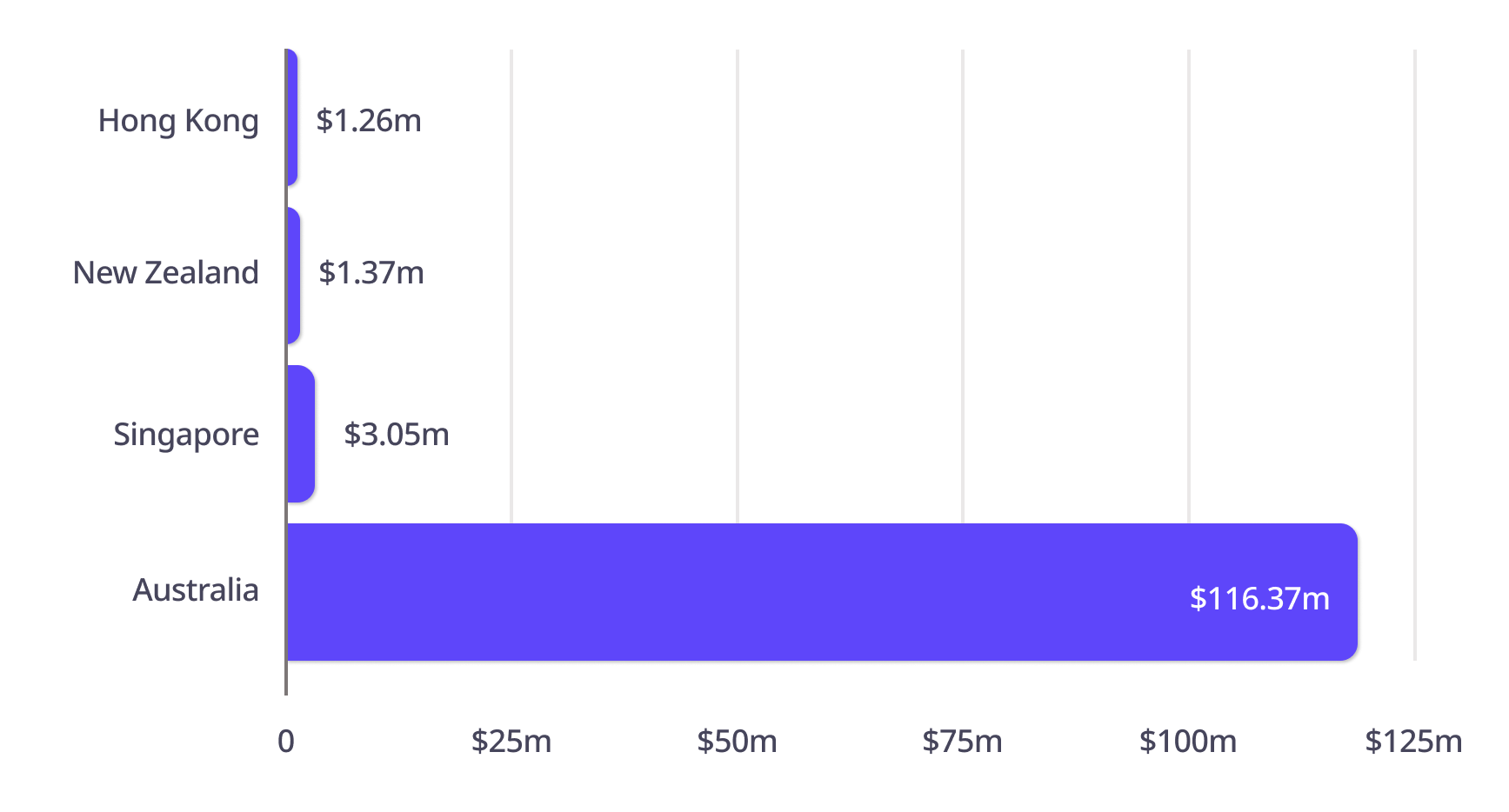
One matter drives most of that. ASIC's action against ANZ, in which the Federal Court ordered A$250 million in combined penalties, covered misreported secondary bond market turnover, artificial pricing pressure and misleading the government about trading volumes. We have included only the A$135 million relating to that conduct; the remainder concerned retail banking matters outside the scope of this analysis. Even on that narrower basis, ANZ accounts for roughly three-quarters of the Australian total.
That single case is a useful reminder that fine totals cannot capture the full extent of enforcement activity, nor should they be read as a proxy for relative market cleanliness. We also need to consider who is being sanctioned and what the sanctions address.
The supervisory structures explored earlier in this series provide useful context.
Australia operates a more regulator-led model. ASIC conducts surveillance directly across licensed markets, but relies heavily on market participants to contribute substantial surveillance work themselves. The regulator has high expectations of "gatekeepers", and has consistently reiterated their role in detecting suspicious activity, investigating red flags, and escalating and intervening effectively.
In Singapore, Hong Kong and New Zealand, exchanges and their regulatory arms play a greater frontline monitoring role, alongside statutory oversight and enforcement by MAS, the SFC and FMA. Firms still have their own surveillance and control obligations. In the enforcement records reviewed, however, actions in these three markets more often target the individuals carrying out or enabling manipulation and insider trading, while Australia's largest penalties address institutional control failures.
The enforcement data reflects that split clearly:
In Australia, the same control failure was prosecuted repeatedly
By the time of the SocGen decision, this was ASIC's fifth enforcement action in fifteen months relating to alleged manipulation in electricity and wheat futures on ASX 24. The regulator was not making an example of one firm; it was working through a market.
For surveillance teams, the message is specific. ASIC identified the venue, the products and the typology, then penalised participants who did not detect what the regulator could see in the same order flow. Firms operating in those markets had ample notice.
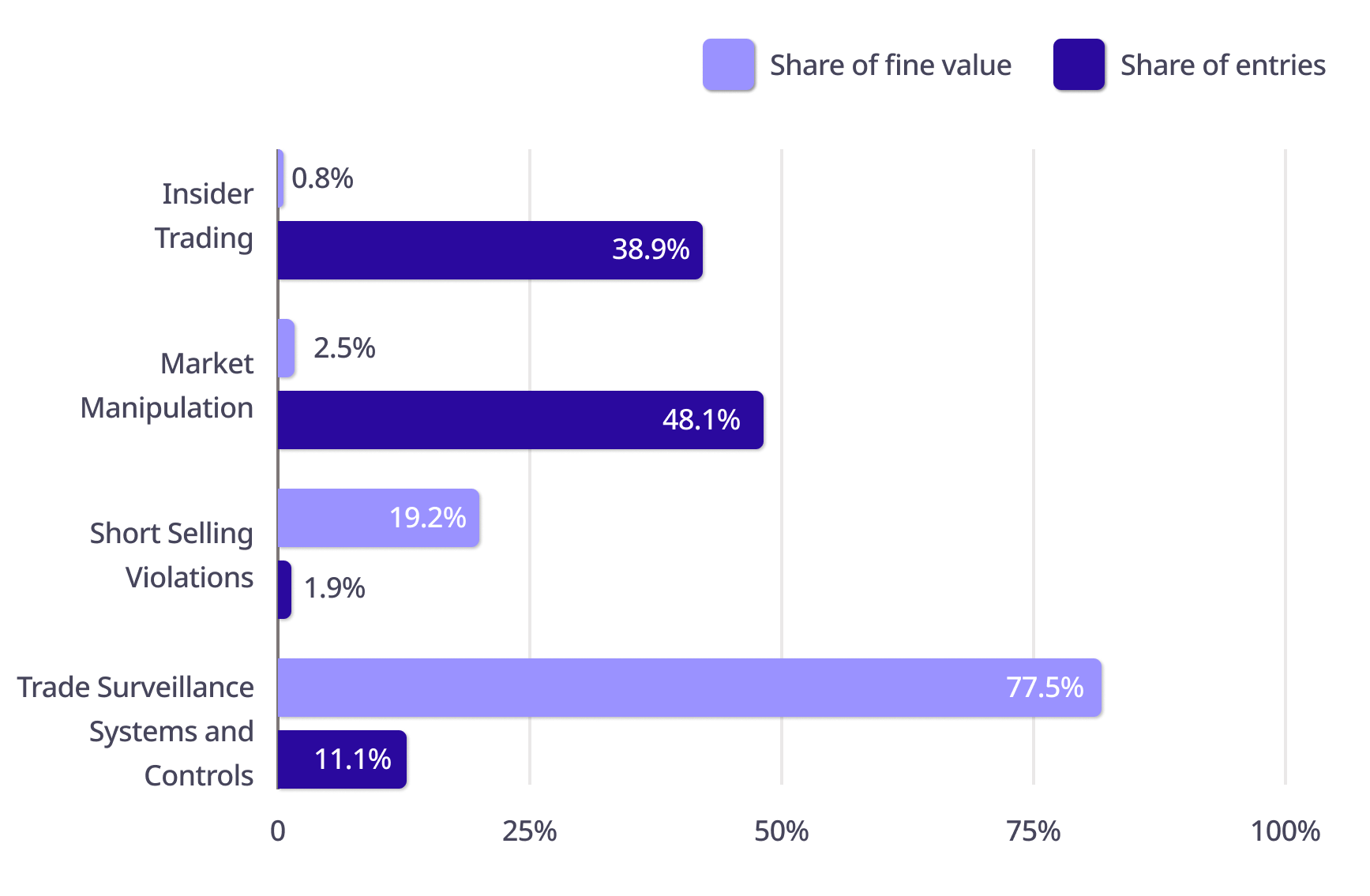
The enforcement mix helps explain the disparity in fine value. In the cases reviewed, substantial penalties against regulated institutions dominate the monetary totals. Manipulation and insider dealing actions more often involve individuals, whose sanctions can include imprisonment, community service or disqualification alongside financial penalties.
The regional fine total is therefore heavily weighted towards institutional misconduct and control failures, even though manipulation and insider trading account for 87% of recorded enforcement entries. Singapore, Hong Kong and New Zealand tell us less about institutional controls and more about the conduct itself.
Singapore's cases turn repeatedly on one question: who is really behind the trading?
False-trading actions consistently involve accounts belonging to employees, trading representatives or other third parties, obscuring who directed or beneficially controlled the activity:
The surveillance challenge is recognising when apparently separate accounts are trading on one person's instructions. Linking those accounts can expose false activity that looks unremarkable in isolation; tracing the instructions identifies the representatives who enabled it.
The typologies are familiar: wash and matched trades, scaffolding, ramp-and-dump. What the Hong Kong cases add is evidence about account relationships, which explain both the trading pattern and its economic purpose.
Three recurring features stand out:
Account relationships must inform the assessment of a trading alert. Separate accounts may look like independent demand until common control is established. Surveillance teams should use those links to assess the accounts' combined contribution to volume and price formation, then test the coordination against order instructions and communications.
New Zealand's smaller enforcement sample limits what we can conclude about current priorities. But one case, involving Oceania Natural Limited (ONL), produced the highest penalties imposed to date under the FMCA's market manipulation and disclosure provisions.
Wei Zhong, ONL's executive chairman and chief executive, and Lei Ding, a senior manager, supported the price of their own company's shares through relatives' accounts, impersonating the account holders and recruiting others to trade. When the broker suspended the original accounts, they continued through other people. Penalties of NZ$1.33 million and NZ$760,000 followed in July 2023, with nine-year management bans in 2024.
The FMA's stated focus on senior managers and directors is clearly visible here, with the people manipulating the stock being the company's own chairman, chief executive and senior manager.
Market abuse is a live enforcement priority in all four markets, and the cases divide fairly neatly into two levels.
The first is the baseline. Across the region, the same typologies recur: false trading, wash and matched trades, scaffolding, marking the close, ramp-and-dump. Monitoring for these, and holding the data quality to run that monitoring reliably, is the floor. It’s clear as day in Australia. Failing to stop, flag or escalate suspicious orders is not an acceptable outcome, and firms have been penalised for it.
But, as we've established across the series, that's just the first step. We’ve already found regulators that are focused on the relationships around a trade. The enforcement record confirms it. In case after case, the conduct ran through employees', relatives', friends' and nominee accounts, sometimes held at other brokers. Those relationships are real and unremarkable, and that is part of the challenge. Establishing who controlled the accounts and who instructed the trading is what turns a set of alerts into a case, and it is where surveillance now has to reach.