Trade surveillance
APAC Market Abuse Regulation: Comparing Australia, Hong Kong, Singapore and New Zealand

Ben Parker
•
Chief Executive Officer & Founder
August 28, 2026

In the first of three blogs on the region, we explore how APAC's regulators approach the challenge of market abuse and the similarities and differences between them.
APAC’s capital markets are attracting growing investor attention, with institutional investors and asset managers increasingly making the case for a “pan-regional” strategy to capture the opportunity.
But APAC is not a single market. It is a collection of jurisdictions with different market structures, regulatory traditions, trading cultures and supervisory models. The same diversity that makes the region an attractive investment opportunity also makes pan-regional surveillance more difficult.
This three-part series seeks to answer a straightforward question: how can firms balance regional consistency with local market-surveillance requirements across APAC?
Focusing on Australia, Hong Kong, Singapore and New Zealand, we will look at:
At the rulebook level, the four regimes are more aligned than firms might assume. The prohibited behaviours, core concepts and regulatory objectives broadly converge. The more meaningful differences lie in how those rules are structured, interpreted and supervised.
All four jurisdictions have central market abuse laws, but they differ in who conducts frontline supervision.
Differences are largely dictated by market structure. Where trading is concentrated around one dominant exchange, keeping surveillance close to that exchange is practical. Where activity is spread across competing venues, there is a stronger case for the statutory regulator to take a market-wide view.
Australia champions the regulator-led model. ASIC conducts surveillance directly across licensed venues and enforces the Market Integrity Rules.
Singapore, Hong Kong and New Zealand operate more dual-layered frameworks. SGX RegCo, HKEX/SEHK and NZ RegCo retain important frontline monitoring or supervisory responsibilities, while MAS, the SFC and FMA retain statutory oversight and enforcement powers.
For firms, that can change who identifies an issue first and how a potential breach moves through the supervisory system.
Australia, Singapore and New Zealand use very similar two-part tests:
Hong Kong is similar too, but its Securities and Futures Ordinance (SFO) is slightly more prescriptive in defining “inside information” as specific information about the corporation, a shareholder or officer, or its listed securities or derivatives, which is not generally known and would be likely to materially affect the price if generally known (s245(2)).
Liability is not limited to directors, employees or other traditional corporate insiders.
Australia has the cleanest possession-based model: any person possessing inside information can potentially be caught (s1043A).
New Zealand is similarly broad, using the concept of an “information insider” rather than relying on formal corporate status (s240 FMC Act).
Singapore distinguishes between “connected persons” (s218) and “other persons” (s219) to ensure the regime explicitly captures both traditional insiders and outsiders who come into possession of inside information.
Hong Kong is more relationship- and circumstance-driven. It still reaches downstream recipients of information, but does so through more defined insider-dealing scenarios involving who had the information, how it was passed on and what the recipient knew about its source and significance (s270).
Again, there is very strong alignment. Across all four jurisdictions, insiders cannot:
The statutes use different language, including “procure”, “counsel” and “advise or encourage”, to describe influencing or causing another person to trade, but the underlying conduct they seek to prevent is the same.
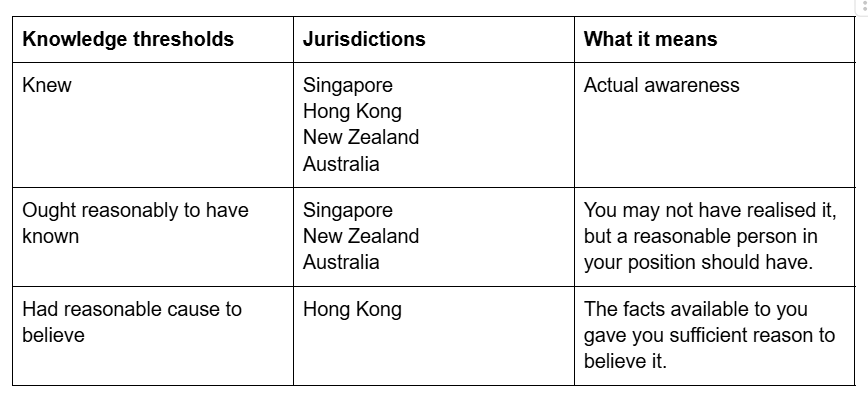
Australia, Singapore and New Zealand all focus heavily on whether the person knew, or ought reasonably to have known, that the information was inside information. Singapore goes further in stating that it is not necessary to prove intention to use the information under s220.
Hong Kong leans on a more structured set of insider trading scenarios, which means the person’s route to the information carries more weight compared to a pure possession-based model. At the top level, the SFC refers to a connected person who has information “which he/she knows is inside information”. Beyond that, the regulator looks at whether or not the individual had reasonable cause to believe the information was sensitive.
To summarise:
The core surveillance scenarios are familiar across the four markets: wash or self-trading, matched or coordinated orders, non-genuine orders such as layering or spoofing, artificial price movement, marking the close and misleading market signals.
There are subtle differences in how those behaviours are expressed in legislation and guidance. Australia’s Corporations Act, for example, expressly captures certain no-change-of-beneficial-ownership trades and matched orders (s1041b(2)), while SGX guidance is particularly detailed on fictitious orders, layering and false-market activity (Rule 13.8.1).
Manipulation does not necessarily have to succeed to attract regulatory scrutiny.
Not every trade that moves a price is manipulative. A large order in an illiquid security may have a significant market impact while still reflecting genuine supply and demand. The key is context. A legitimate commercial rationale can point strongly towards genuine trading, but it’s not a free pass. Firms still need to weigh that rationale against how the trade was executed and the market effect it created or was likely to create.
Regulators and exchanges therefore look at the wider circumstances: why the order was placed, its size relative to liquidity, price impact, beneficial ownership, trading history, and whether orders were subsequently amended or cancelled.
Australia is the most effects-led of the four. The core question is whether conduct creates, or is likely to create, an artificial price or false or misleading appearance of trading. A commercial rationale matters, but it does not override an objectively artificial market effect.
New Zealand adds a clearer knowledge/reasonableness test. The regulator looks not only at the likely effect of the conduct, but also whether the trader knew or ought reasonably to have known that it would create a false or misleading market appearance (s.265).
Singapore combines both approaches. Some provisions focus on false-market effects, while others look more directly at purpose or intent (s197/198).
Hong Kong is the most explicitly intent/recklessness-led for certain offences. False trading under the SFC asks whether the conduct was intended, or carried out recklessly, to create a false or misleading appearance.
While the headline rules converge, the legal tests underneath them can change how an alert is interpreted. The same trading pattern may be viewed differently depending on whether the local regime places greater weight on effect, knowledge, intent, recklessness or the information chain. That, in turn, shapes how alerts are investigated, what evidence matters and how firms distinguish genuine trading from abuse.
So, in practice, firms can standardise the core behaviours they monitor for, but the judgement applied to those alerts cannot be entirely uniform.
The legislation gives us part of that picture, but to understand how those differences translate into day-to-day surveillance expectations, firms also need to look at regulator guidance, exchange rules and supervisory commentary.
That’s where we’re going next, starting with what regulators across the four markets have been saying over the past year; where scrutiny is increasing, which risks are moving up the agenda and what they expect firms to improve. We’ll then turn to recent enforcement to see where surveillance and controls are actually breaking down in practice.